Your AI Agent Demo Looks Impressive. What Workflow Disappears?
Most AI agent demos automate fake work. Real AI automation replaces an existing business workflow across revenue, delivery, or operations, with clean data, human approval, CRM feedback, and repeatable execution.
Posted by
 Jet
JetRelated Reading
Your Team Uses AI. Your Business Still Doesn't.
Why most small businesses remain stuck between AI experiments and operational automation, plus a practical maturity model and 30-day plan for closing the integration gap.
How AI Finds Wasted Ad Spend Before Your Marketing Team Does
A practical AI ad audit playbook for SMBs, SaaS teams, and digital businesses: find wasted spend, diagnose creative fatigue, catch landing page mismatch, and turn ad reports into weekly optimization briefs.
7 AI Automation Tasks for Small Business Owners in 2026
A practical 2026 guide for small business owners: seven repetitive tasks to automate with AI, with workflows, tool stacks, examples, and a 30-day rollout plan.
Your AI Agent Demo Looks Impressive. What Workflow Disappears?
The question is not "can AI do this?"
The question is: what workflow disappears if this works?
That is the difference between a useful AI automation system and another impressive demo that quietly creates more work for the team.
If your AI workflow does not touch revenue, delivery, or operations, it is probably a toy.
I do not care how polished the demo looks.
Can it create qualified pipeline?
Can it reduce manual delivery work?
Can it remove an operational bottleneck?
Can it make a decision loop faster?
Can it give your team time back?
If not, it is not automation.
It is an AI experiment with better branding.
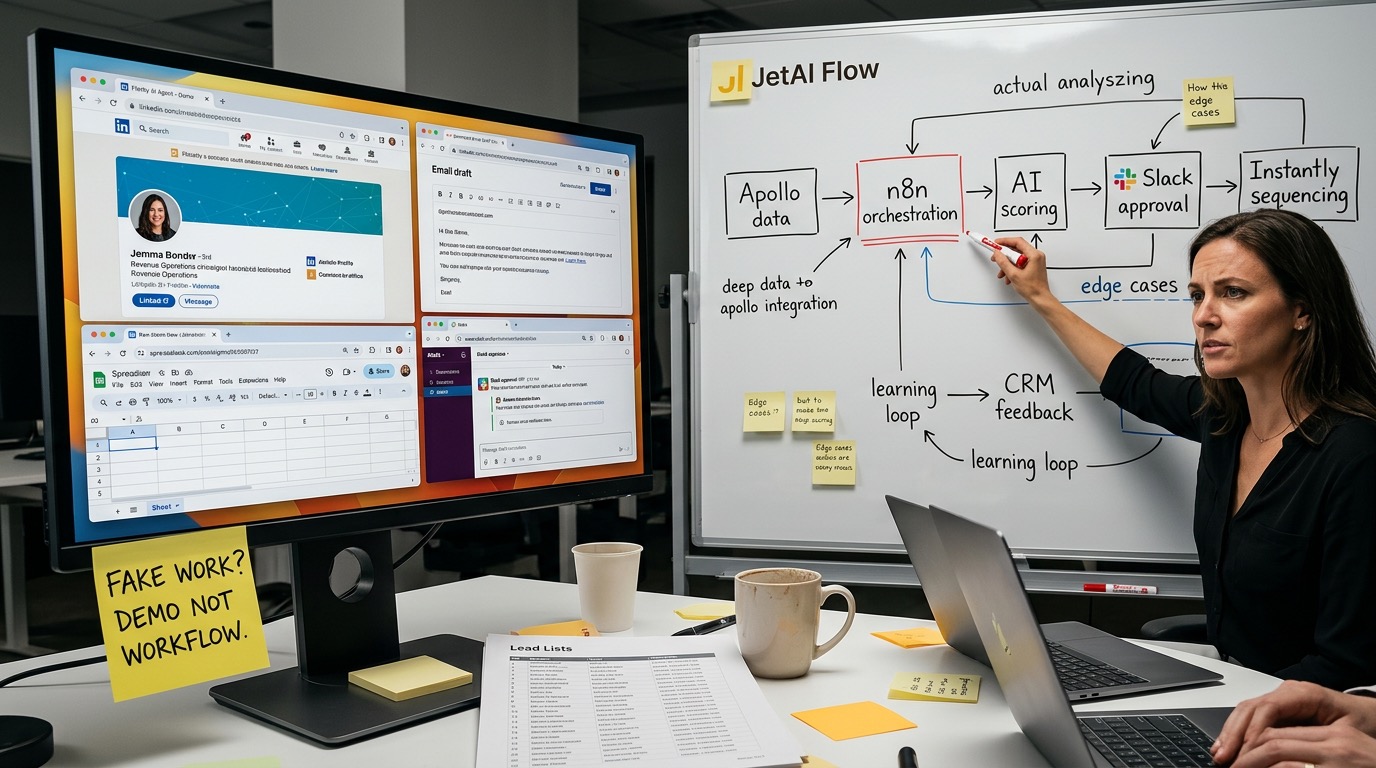
The AI demo trap
You have seen this demo.
The agent opens a browser.
It scrapes a LinkedIn profile.
It summarizes a post.
It writes a message.
It adds a row to a spreadsheet.
It sends a Slack notification.
It looks useful.
It feels like the future.
Then the real business process begins.
Someone still has to clean the data. Someone still has to decide whether the lead is actually qualified. Someone still has to rewrite the message. Someone still has to move the lead into outreach. Someone still has to track replies. Someone still has to update the CRM. Someone still has to remember what worked.
That is not workflow automation.
That is AI-assisted task generation.
The distinction matters because most companies do not need more generated tasks. They already have too many. They need existing workflows to become shorter, cleaner, more reliable, and more self-improving.
An AI demo is allowed to be impressive.
An AI workflow has to be accountable.
A simple test: where does the work go next?
When evaluating an AI agent, ask one brutal question:
After the agent finishes, what does the human still have to do?
If the answer is "most of the business process," the agent did not automate the workflow. It created an artifact.
Artifacts are not bad. A summary, draft, enriched row, or recommendation can be useful. But artifacts only become automation when they replace a defined step inside a real operating system.
For example:
| AI output | Looks like automation | Real workflow question |
|---|---|---|
| Drafted cold email | "AI writes outreach" | Who decides the lead is worth contacting? |
| LinkedIn profile summary | "AI researches prospects" | Where does qualification happen? |
| Spreadsheet row | "AI builds lead lists" | Is the CRM updated and deduplicated? |
| Slack notification | "AI alerts the team" | Who owns the next action? |
| Browser scraping task | "AI collects data" | Is the data reliable enough to scale? |
The workflow does not become real until the next action is clear.
Who approves?
Where does the record live?
What happens on reply?
What improves after the result?
If the system cannot answer those questions, it is not business automation. It is a prettier way to stay busy.
Why this mistake happens
AI demos reward novelty.
Businesses reward reliability.
Those incentives are different.
A great demo only needs to work once in a controlled environment. A real workflow has to run hundreds or thousands of times under messy conditions: incomplete data, duplicate contacts, stale titles, angry replies, bounced emails, missing fields, unclear ownership, and people who forget to update systems.
That is why boring infrastructure often beats flashy agent autonomy.
n8n is not impressive because it feels magical. It is impressive because it makes execution repeatable.
CRM is not exciting. It is valuable because it is the source of truth.
Slack approval is not futuristic. It is useful because human judgment enters at the right moment.
Feedback loops are not cinematic. They are how the system gets smarter.
Business does not pay for the agent's freedom.
Business pays for the workflow's reliability.
Agents are great for exploration
This does not mean AI agents are useless. It means you should use them at the right stage.
Agents are excellent for exploration.
When you are trying to get your first 20 conversations, your first 100 users, or your first signal from a new market, speed matters more than structure.
At that stage, an AI agent can be genuinely useful:
- Scan LinkedIn posts.
- Monitor X conversations.
- Find people complaining about CRM, outbound, lead quality, RevOps, manual operations, or AI automation.
- Summarize why they might be relevant.
- Draft first-touch messages.
- Help you learn which pains actually resonate.
- Surface unexpected communities, job titles, and buying triggers.
This is also where Apify can be useful.
For short-term validation, Apify is great for pulling messy public signals from LinkedIn, X, directories, websites, communities, and niche pages.
You do not need perfect data.
You need fast signal.
At small scale, messy data helps you learn.
But the moment outbound becomes a real growth channel, the stack needs to change.
Why scraped-data workflows break at scale
Scraped data is useful for discovery, but dangerous as a scaled outbound foundation.
The reasons are not philosophical. They are operational.
Profiles are incomplete. Job titles are inconsistent. Company information needs cleanup. Public signals go stale. Source structures change. Duplicate people appear across tools. Context is hard to verify. The more volume you push through noisy data, the faster you burn deliverability and trust.
At small scale, messy data gives you learning.
At large scale, messy data makes you look sloppy.
This is the moment where many teams get fooled by their own AI demo. They prove an agent can find "interesting leads," then they try to scale that same workflow as if interesting equals qualified.
It does not.
Scaled outbound requires cleaner data, explicit scoring, ownership, approval, deliverability controls, CRM hygiene, and feedback loops.
Without those, AI simply helps you send more mediocre messages faster.
That is not leverage.
That is risk.
A real scaled outbound workflow
A practical scaled workflow looks much less glamorous than most agent demos.
That is a good sign.
Here is the stack:
- Apollo for cleaner lead and company data.
- n8n as the orchestration layer.
- AI for lead scoring, enrichment, segmentation, and message-angle suggestions.
- Slack for human-in-the-loop approval.
- Instantly for sequencing and deliverability.
- CRM as the source of truth.
- Feedback loops from replies, rejections, booked calls, and closed deals.
Here is what this looks like in practice:
- Apollo pulls companies that match your ICP.
- n8n filters by company size, role, region, industry, and tech stack.
- AI scores the lead based on fit and recent signals.
- AI suggests the outreach angle, not just the email copy.
- The lead is pushed into Slack with context.
- A human approves, rejects, or edits the angle.
- Approved leads go into Instantly.
- Replies and bounces flow back into Slack.
- Positive replies update the CRM.
- Rejections improve the scoring logic.
- Booked calls teach the system which ICP and message angle actually work.
That is the difference.
A demo shows AI doing a task.
A workflow makes the business smarter every time it runs.
The important part is not the email
Most people over-focus on the generated email.
That is the least interesting part of the system.
The real unlock is not:
"AI can write an email."
The real unlock is:
- Who should we contact?
- Why now?
- What pain point should we lead with?
- Who needs to approve it?
- What happens after we send it?
- What does the system learn?
The message is only one artifact in a larger decision loop.
If the lead is wrong, the copy does not matter.
If the timing is wrong, the copy does not matter.
If the CRM is not updated, the team does not learn.
If replies do not feed back into scoring, the system stays dumb.
If deliverability is damaged, the channel gets weaker with every run.
This is why a boring n8n workflow can beat 90% of AI agent demos.
Not because n8n is more magical.
Because it gives the business a repeatable operating system.
What should disappear?
A serious AI automation project should remove or shrink a real manual workflow.
Before building, write the old workflow down.
For outbound, the old workflow may look like this:
- Search for companies.
- Find contacts.
- Clean titles and roles.
- Guess fit.
- Research pain points.
- Draft message.
- Get approval.
- Add to sequencer.
- Track replies.
- Update CRM.
- Review performance.
- Adjust targeting.
Now ask: what disappears?
The answer should be specific:
- Manual lead list building drops by 80%.
- First-pass lead scoring becomes automatic.
- Message-angle research becomes AI-generated and human-approved.
- Sequencer entry happens only after approval.
- Positive replies create CRM updates automatically.
- Rejected leads feed back into ICP rules.
- Weekly learning summaries are generated without manual reporting.
That is workflow replacement.
Notice that humans are still involved. They are just involved where judgment matters.
The system removes mechanical work, not accountability.
The human-in-the-loop point
Human-in-the-loop is often treated as a weakness.
It is actually the control system.
For revenue workflows, you do not want AI blindly deciding who receives outbound, what gets promised, or how your brand sounds in market. You want AI to prepare the decision and a human to approve the action.
The right pattern is:
AI proposes.
Human approves.
System executes.
Results feed back.
AI improves the next proposal.
That loop is much more valuable than full autonomy in the wrong place.
When a lead appears in Slack, the human should not see only a generated email. They should see:
- Company.
- Role.
- Fit score.
- Relevant signal.
- Suggested pain point.
- Proposed angle.
- Reason for approval.
- One-click approve/reject/edit.
That is how AI becomes operational.
It does not replace judgment. It moves judgment to the point of highest leverage.
What improves after 100, 1,000, or 10,000 runs?
This is the compounding question.
If your AI workflow runs 1,000 times and the business is not smarter afterward, something is wrong.
A real workflow should accumulate learning:
- Which ICP segments reply.
- Which titles convert.
- Which company signals matter.
- Which pain points create calls.
- Which message angles underperform.
- Which data sources produce bad leads.
- Which approval reasons predict success.
- Which objections appear repeatedly.
- Which campaigns damage deliverability.
Without that feedback loop, the automation is just throughput.
With the feedback loop, the workflow becomes an intelligence system.
This is where AI becomes strategically valuable.
Not because it writes.
Because it learns which work is worth doing.
The implementation checklist
Before building an AI workflow, answer these questions:
- What existing workflow are we replacing or compressing?
- Which business metric should improve? Pipeline, delivery speed, margin, response time, retention, or operating cost?
- Where does the source data come from?
- How clean and durable is that data?
- What is the AI allowed to decide?
- Where does human judgment enter?
- What system becomes the source of truth?
- What happens after the AI output is approved?
- What happens when the output is rejected?
- What improves after 100, 1,000, or 10,000 runs?
If you cannot answer these questions, do not build the agent yet.
Map the workflow first.
Then automate.
The bottom line
AI agents are great for exploration.
Workflows are what make the learning compound.
The impressive demo is not the goal. The disappearing manual workflow is the goal.
So before building another fancy AI agent, ask:
What manual step disappears?
What decision gets faster?
Where does human judgment enter?
Where does feedback come back?
What improves after the system runs 1,000 times?
If you cannot answer those questions, you are not building AI automation.
You are building fake work with better branding.